Sunday, December 11, 2011

THE SOUTHERN COASTLANDS

Aside from being one of the many tourist spots in the United States and the world, Hawaii is also famous (unfortunately) for having hurricanes, like the Southern Coastlands.


A Hawaiian hurricane is a tropical cyclone that forms in the Pacific Ocean and affects the Hawaiian Islands. Hawaiʻi lies in the central Pacific, where about four or five tropical cyclones appear each year, although as many as eleven have occurred, such as in the 1992 and 1994 seasons; rarely do these storms actually affect Hawaiʻi. Before the 1950s, when tropical cyclone records were not kept, many windstorms struck Hawaiʻi; if these storms were in fact hurricanes, they were not so identified.


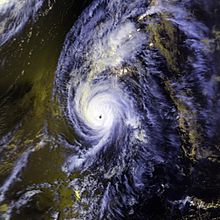
The most significant hurricane in the island of Kauai is Iniki. It was the most powerful hurricane to strike the U.S. state of Hawaiʻi in recorded history. Forming on September 5 during the strong El Niño of 1991–1994, Iniki was one of eleven Central Pacific tropical cyclones during the 1992 season. It attained tropical storm status on September 8 and further intensified into a hurricane the next day. After turning to the north, Iniki struck the island of Kauaʻi on September 11 at peak intensity; it had winds of 145 mph (235 km/h), and was a Category 4 hurricane on the Saffir-Simpson Hurricane Scale. It was the first hurricane to hit the state since Hurricane Iwa in the 1982 season, and the first major hurricane since Hurricane Dot in 1959. Iniki dissipated on September 13 about halfway between Hawaii and Alaska.
Iniki caused around $1.8 billion (1992 USD) of damage and six deaths. At the time, Iniki was among the costliest United States hurricanes, and it remains one of the costliest hurricanes on record in the eastern Pacific. The storm struck just weeks after Hurricane Andrew—the costliest tropical cyclone ever at the time—struck the U.S. state of Florida. It was also one of two Category 4 hurricanes to strike the United States that year, as Andrew made landfall in Florida as a Category 5 just a few weeks earlier.
The Central Pacific Hurricane Center (CPHC) failed to issue tropical cyclone warnings and watches for the hurricane more than 24 hours in advance. Despite the lack of early warning, only six deaths were attributable to the storm. Damage was greatest on Kauaʻi, where the hurricane destroyed over 1,400 houses and severely damaged over 5,000. Though not directly in the path of the hurricane's core, Oʻahu still experienced moderate damage from wind and storm surge.


SOURCES:
http://en.wikipedia.org/wiki/List_of_Hawaii_hurricanes
http://en.wikipedia.org/wiki/Hurricane_Iniki
http://www.pricip.org/ea-portal/web/guest/3?p_p_id=InikiImpactsTitle_WAR_pricip&p_p_action=0&p_p_state=normal&p_p_mode=view&p_p_col_id=column-1&p_p_col_count=4&_InikiImpactsTitle_WAR_pricip_photo=3
http://the.honoluluadvertiser.com/150/sesq5iniki

Sunday, October 16, 2011

THE CHANGING SOUTH


Founded in 1984, the Kauai Economic Development Board (KEDB) is a 501(c)(3) non-profit, member-based organization. KEDB’s members include a variety of Kauai businesses, community organizations, legislators, and government officials. KEDB is improving the quality of life in the County of Kauai from Haena to Barking Sands and PMRF every day by:


  • Developing Partnerships to diversify the economy
  • Initiating Efforts To Educate Local Youth so they can succeed in the global marketplace
  • Nurturing Key Economic Clusters including: Food & Agriculture, Health & Wellness, Sports & Recreation, Arts & Culture, High Technology and Renewable Energy.

In this way, KEDB comprehensively addresses the island’s economic issues from assisting businesses with creating new jobs on Kauai to facilitating Kauai job and career opportunities for local students, to promoting affordable housing, and more. KEDB is a proven leader in doing what needs to be done to advance a strong, sustainable economy on Kauai.


This is located outside the fire station in Poipu, taken sometime in 2010

APPALACHIA AND THE OZARKS

Kauai is home to a total of 235 mountain summits and peaks.


KALALEA MOUNTAIN


Kalalea Mountain is often refered to as King Kong, because it resembles king kongs profile from the side. This mountain is located in Anahola, Kauai and is covered in vegetation and poor quality rock that breaks easily. But it was still a blast to climb in such a lush vegetated location.


NOUNOU MOUNTAIN (Sleeping Giant)


Stare at the ridge from afar and with a little imagination you can make out what looks like a human figure lying on his back. Hawaiian legends say this giant was tricked by villagers into eating a vast amount of rocks hidden in fish and poi. Sleepy from the meal, the giant took a nap and hasn’t woken since.


A view from Waimea mountain top, on the way to Kokee State park, taken from my vacation in April 2010


Sources:
http://www.mountainzone.com/mountains/list-mountains.asp?cid=45734
http://www.mountainproject.com/v/kalalea-mountain-kauai/106935411
http://www.gohawaii.com/kauai/regions-neighborhoods/east-side/sleeping-giant
http://www.hawaiiweb.com/kauai/html/sites/sleeping_giant.html

THE BYPASSED EAST


Palm trees sway in intoxicating trade-winds along the white sand beaches of Kauai's East Side. Nicknamed the "Coconut Coast” for the widely dispersed and plentiful coconut trees that landscape the coastline.
The East Side of the Garden Island is full of activity and is central area of commerce on Kauai. Here you will find the towns of Lihue, Puhi, Nawiliwili, Kapaa, Wailua, Waipouli and Anahola. Lihue is the county seat of Kauai and where you will find the main shipping port of Nawiliwili Harbor, Wilcox Hospital, Kauai Community College, Kauai Museum, and our government offices. 
It’s easy to imagine old world simplicity while exploring the Kauai Coastal Path (Ke Ala Hele Makalae), numerous parks, beach-side cafes, and Hawaiian small town charm.
Kauai Attractions on the East Side include the Wailua River,Fern Grotto (an up-river amphitheater-like fern covered area popular for weddings),Keahua Arboretum, Nounou Mountain, Opaekaa Falls,Wailua Falls (most famous for the opening scene in the television show “Fantasy Island”) as well as many beautiful beaches. 


Sources: http://www.kauai.com/east-side
              http://en.wikipedia.org/wiki/File:SleepingGiant.jpg

THE NORTH AMERICAN MANUFACTURING CORE

While Kaua`i is ranked fourth in the state in terms of total visitor arrivals (after O`ahu, Maui and Hawai`i), during a typical year the visitor industry on Kaua`i contributes a very significant percentage to the County’s real income and is said to be the single largest industry on the Garden Isle.
According to the University of Hawai`i Economic Research Organization’s Kaua`i Economic Outlook (June 2004), Kaua`i visitor arrivals on mainland flights ran 2.7% above prior year levels during the first four months of 2004.
Despite global setbacks to the travel and tourism industry in 2001-2003, Kauai’s visitor industry has made a very strong comeback with near future forecasts very favorable. In recent years, Kauai’s economy has fared significantly better than other neighbor islands, even during soft periods.
Part of Kauai’s success is due to Kauai’s strength in the domestic travel market as well as the large number of time-share and condominium owners who have kept Kauai’s visitor industry busy when other destinations were not as fortunate. Time share units on Kaua`i represented 35% of the state’s total in 2002 and one-fifth of all accommodation on the Island.


AGRICULTURE


Kauai’s agriculture started in the early Hawaiian lo`i kalo (terraced taro fields) and continues to form a vital part of the economy of this tropical rural county.

The aptly named Garden Island is, from an agricultural perspective, a challenging, but rewarding place to do business. Kauai’s 365-day-a-year growing season affords farmers and gardeners the opportunity to grow everything from tropical fruits and flowers to traditional Polynesian and row crops, endangered native plants and exotic hardwoods.
The largest coffee estate in the U.S. is the Kaua`i Coffee Company on Kauai’s south side which has 3,400 acres dedicated to growing an annual yield of 3.5 million pounds (60% of Hawaii’s total output).
In terms of economic value, Kauai’s number one crop today is seed corn which is grown largely on west Kaua`i and exported to the U.S. mainland. Other important crops include coffee, guava, taro and sugar.
On the north shore of Kaua`i, Kilauea Agronomics, Inc. (Guava Kai) has transformed former sugar land into 450 acres of guava orchards, producing 12 million pounds of fruit annually.
Also on the north shore, in the Hanalei Valley, roughly two-thirds of Hawaii’s six million pounds of poi taro (an important traditional Hawaiian staple) is grown and processed.
Sugar, for 150 years the leading crop of Hawai`i, is currently grown commercially in only two places in Hawai`i, one of which is Gay & Robinson, Inc. on Kaua`i’s west side. Gay & Robinson, that maintains 8,781 acres, grew 21% of Hawaii’s sugar, 59,085 tons, in 2004.
Additionally, Kaua`i farmers grow papayas, bananas, tropical specialty fruits like rambutan, lychee and longan, row crops like bok choi and lettuce as well as hardwoods like teak, mahogany, albizia, and tropical flowers, although none of these are major crops now.
Beef cattle are also raised and exported to the U.S. mainland while small hog and chicken operations remain for domestic consumption.


MEGALOPOLIS

Lihue is an unincorporated community settled on the southeastern shores of Kauai Island, Hawaii. Lihue is close to the Kauai's main airport and chief port on Nawiliwili Harbor. It is a commercial, distribution, and tourist center. The Lihue Sugarcane Plantation was established by the Germans in 1849. On top of that, The Kauai Museum and community college are located in Lihue as well! For a community population of 5,674 that is quite a few attractions indeed.

The name Lihue was taken from the cool winds of the town thus the name literally means, "cold chill." It is the second biggest town of Kaua'i which houses some of the famous names in commercial centers, such as Macy, Home Depot, and K-Mart. Lihue may not be a tourist capital of Hawaii, but it has the largest commercial industry in the bountiful island of Kaua'i

Even though Lihue is a rural town with its abandoned plantations and open field roads, it contains the best hotels, shopping centers, and historic museums. It's a town full of paradoxes since its roads show no sign of development. Yet most of the commercial establishments can be found in the area. Sadly, Lihue doesn't have a long historic background to boast of as compared with other towns. It only came to being during the mid-1900's. Before, Lihue was a simple town that worked in the Grove Farm sugar plantation. Just like most towns in Kaua'i, sugar plantation was one of the major sources of living in Lihue.


A Kauai rule is that no building may exceed the height of a coconut tree, between three and four stories. As a result, the island itself, not its palatial beach hotels, is the attention grabber. There's no real nightlife here, no opulent shopping malls. But there is the beauty of the verdant jungle, the endless succession of spectacular beaches, the grandeur of Waimea Canyon, and the drama of the magnificent Na Pali Coast. Even at Princeville, an opulent marble-and-glass luxury hotel does little more than frame the natural glory of Hanalei's spectacular 4,000-foot-high Namolokama Mountain Range.


FOUNDATIONS OF HUMAN ACTIVITY


Compare the lush, time worn cliffs of the Napali Coast with the fresh black lava shores ofHawaii’s Big Island and you’ll understand what makes Kauai the oldest island in the Hawaiian chain. Kauai’s distant past is filled with legends, the most well known tells of the Menehune, a mythical race of small people talented in construction and engineering who created Kauai’s aqueducts and fishponds, often in a single night. They were believed to have lived in the woods and were shunned by Hawaiians. Today, you can still see their work at Hawaiian fishponds like Alekoko, known as Menehune Fishpond, near Lihue.
In 1778, British explorer Captain James Cook landed in Kauai’s Waimea Bay for the first time. Cook’s discovery of what he called the “Sandwich Isles,” named after the Earl of Sandwich, introduced Hawaii to the world. A statue of Captain Cook stands today in Waimea Town.
During this era of western discovery, King Kamehameha I was attempting to unify the Hawaiian Islands under his rule. Kauai and the small neighboring island of Niihau (part of Kauai county) were the only islands to deter his efforts. Eventually, Kauai’s King Kaumualii decided to peacefully unite with Kamehameha and join the rest of the Kingdom of Hawaii.
In 1835 Old Koloa Town opened its first sugar mill. Follow the Koloa Heritage Trail in Old Koloa Town today to learn about Kauai’s plantation past. On the North Shore, tour the Waioli Mission House, on the National Register of Historic Places, to get a glimpse of missionary life in the 19th century. You can also visit the Kauai Museum for a fascinating exploration of exhibits, artifacts and murals portraying the history of Kauai, its people and its unique culture.

2010 U.S. Census - Kauai County

Population: 67, 091
33% of population are white
31.3% of population are Asians
30.7% of population are white, non Hispanic
24.9% of population are reporting two or more races
9% of population are Native Hawaiian and other Pacific Islanders


Sources: http://quickfacts.census.gov/qfd/states/15/15007.html
              http://www.city-data.com/county/Kauai_County-HI.html
              http://198.85.71.234/hyrowskipa/cis172final/history.html